Liquid Shingle: A Roof With No Seams to Leak
A liquid shingle is not a shingle at all — it is a roof sprayed on as a liquid that cures into one continuous rubber-like sheet, with no laps, no nails, and no edges for water to work under. The material is polyurea: OR-80SLM Silver Lining Membrane and OR7K, the same chemistry used on commercial roofs and approved by Miami-Dade.
See If Your Roof Is a CandidateStart Here: What a Liquid Roof Actually Is
It Arrives as Liquid and Becomes a Sheet
Two chemicals meet inside the spray gun, react in about four seconds, and cure into a solid elastic membrane on your roof. What you end up with behaves like a single rubber sheet stretched over the entire structure — except it was formed in place, so it fits every valley, vent, and edge perfectly.
No Seams Means No Leak Points
Almost every roof leak in the world starts at a joint: a shingle overlap, a nail hole, a flashing edge, a vent boot that dried out. A liquid-applied roof has none of those. The membrane runs up and over each detail without interruption, so there is simply nowhere for water to enter.
It Stretches Instead of Cracking
Your roof grows and shrinks every single day as the sun comes and goes. Rigid materials eventually fatigue and split at that stress. Polyurea stretches to three or four times its own length and springs back, absorbing the movement rather than fighting it.
It Goes Over What You Already Have
In most cases the existing roof stays put and becomes the substrate. No tear-off, no dumpster in the driveway, no days of your house standing open to the weather. Cleaning and priming are the real work — the spray itself is usually a single day.
Roofs Liquid Shingle Suits
Liquid-applied roofing is best on low-slope and metal surfaces, and on roofs where the detail work is what keeps failing.
- Low-slope & flat home roofs
- Metal roofs & porch roofs
- Rolled asphalt & modified bitumen
- Flat additions & dormers
- Sound asphalt shingle roofs
- Manufactured & mobile home roofs
- Garages, sheds & carports
- Sunrooms & patio covers
- Cabins & seasonal buildings
- Small commercial & mixed-use roofs
The Materials Behind It
A liquid roof is a system, not a single bucket. These are the real products and what each one is for.
Why the Name Is a Little Misleading
"Liquid shingle" is what people search for, so it is what we called this site. But it is worth being straight with you in the first paragraph: there is no shingle involved. Nothing overlaps. Nothing is nailed down. When it cures you do not have small pieces arranged in rows — you have one piece.
That is the entire idea. Traditional roofing is a strategy of managed overlap. You lay hundreds of small units in a pattern so that gravity carries water down across the joints instead of through them. It works beautifully until a joint moves, a fastener backs out, a wind event lifts a course, or a flashing detail dries out. Then water finds the one path you did not manage.
Liquid-applied roofing takes the joints out of the equation. The material goes down as a liquid, flows into every valley and around every vent, and cures into a continuous elastic membrane bonded to the surface underneath. There is no overlap to manage because there is no overlap.
This is not a new idea, and it is not experimental. Liquid-applied membranes have been standard on commercial and industrial roofs for decades. What has changed is that the equipment and the chemistry are now practical for houses, garages, additions, and manufactured homes.
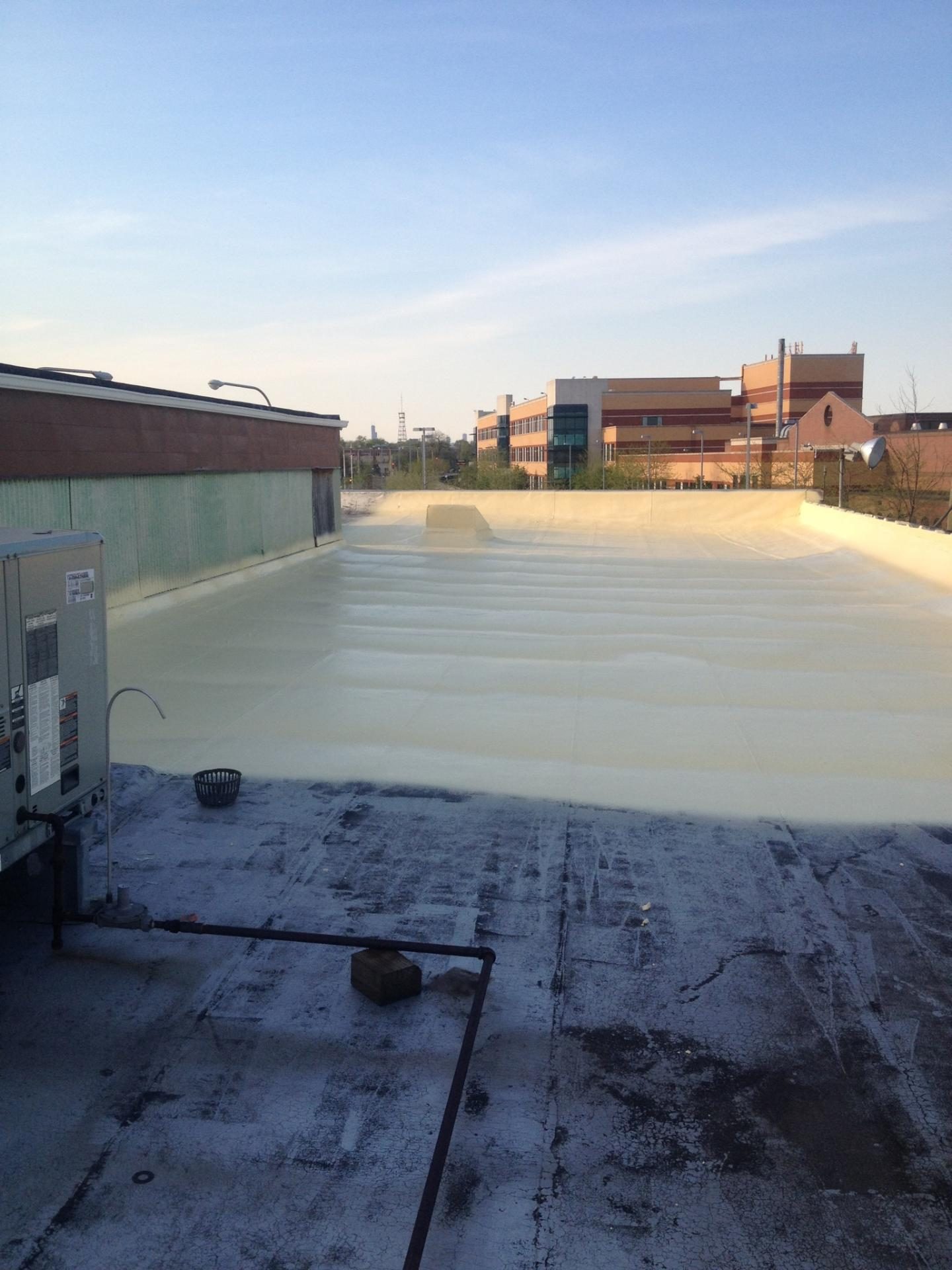
What Happens on Installation Day
- The roof gets cleaned. Pressure wash, remove anything loose, and let it dry. Most of the labor on a liquid roof job is preparation, and it is the part that determines whether the result lasts.
- Repairs and details go first. Open seams, rusted fastener heads, soft spots, and old vent boots are addressed before anything is sprayed. A membrane cannot fix a structural problem beneath it.
- 7001 Primer is applied. This is what bonds the new membrane to whatever is already there — asphalt, metal, single-ply, concrete, or wood — and it seals in old asphalt so it cannot bleed through and stain the finished surface.
- The membrane is sprayed. OR-80SLM goes on in one continuous pass at 40 to 60 mil. It gels in seconds and is tack-free in under a minute, so the roof is weathertight almost immediately behind the gun.
- You can walk on it that afternoon. Same-day return to service is normal. There is no multi-day cure, no waiting on dry weather windows to finish a partially completed section.
Liquid Roofing at a Glance
And Where It Is Not the Answer
We would rather you find this out here than after a sales call.
If you want it to look like shingles, it will not. A liquid roof is a smooth, uniform, monolithic surface. On a steep front-facing roof in a neighborhood with an HOA, that appearance is often the deal-breaker, and no amount of technical merit changes it.
If the roof deck is rotten, coating it is a mistake. A membrane is waterproofing, not structure. Spongy sheathing, sagging rafters, or wet insulation have to be fixed or removed first. Spraying over them buys a season and costs you the repair twice.
If the existing roof is falling apart, it has to come off. The membrane bonds to what it is sprayed on. If that layer is delaminating, curled, or loose, the new roof leaves with the old one.
Where it genuinely shines: low-slope and flat roofs, metal roofs, additions and porches with awkward transitions, manufactured homes, and any roof whose leaks all trace back to details rather than to the field of the roof.
Tell Us About Your Roof and We Will Be Honest
Send the roof type, the approximate size, the slope, and where it leaks. If liquid-applied roofing is the right call we will spec it and connect you with a trained applicator in your area. If it is not, we will tell you that instead.
See If Your Roof QualifiesSee If Your Roof Is a Candidate
Tell us about your project and we will follow up with product details, technical data sheets, and pricing.
Frequently Asked Questions
Questions People Ask First
Most of these come from homeowners who had never heard of liquid roofing a week ago.
The Basics
Is this a real roof, or is it just paint?
It is a real roof, and the difference from paint is thickness and chemistry. House paint is roughly 2 mils thick and is a decorative film. This membrane is applied at 40 to 60 mils — twenty to thirty times thicker — and it is an elastomer with 2,500 PSI tensile strength that stretches to three or four times its length. It is the waterproofing layer of the roof, not a coating on top of one.
Will it look like shingles when it is done?
No. It is a smooth, uniform surface in a solid color. If the roof is highly visible from the street and appearance is the priority, this is probably the wrong product and we will say so. It is chosen for flat roofs, metal roofs, back-of-house sections, additions, and manufactured homes where function matters more than the look of individual shingles.
Can it really go over my existing roof?
In most cases yes, and that is a large part of the appeal — no tear-off, no dumpster, no house standing open. The condition of what is already there decides it. Sound and well-adhered means we clean, prime, and spray. Curled, blistered, delaminating, or waterlogged means it comes off first, because the new membrane can only be as attached as the layer beneath it.
How long does the installation take?
For a typical house roof, one to three days total, and most of that is cleaning, repairs, and priming. The spray itself is often a single day. The membrane is tack-free within a minute and walkable the same afternoon, so you are not living around an open roof for a week.
Durability & Performance
How long does it last?
A properly prepped and correctly specified polyurea membrane is a long-service roof, not a maintenance coating on a recoat cycle. The variable is almost never the material — it is the preparation and the film thickness. This is why we push so hard on cleaning, priming, and getting the mils right, and why we are careful about who applies it.
What about hail, wind, and falling branches?
Wind uplift is where it does best: there are no individual pieces to lift, no exposed edges to catch, and the membrane is bonded across the whole surface — which is a large part of why OR-80SLM carries Miami-Dade approval. For impact, tear strength runs 400 to 500 pli, and on hail-prone roofs we spec Flak Jacket 1 in the exposed areas. If something does gouge it, the repair is a patch of the same material that chemically bonds to the original.
Does the color fade?
Aromatic polyurea chalks and lightens in direct sun over time. This is cosmetic only — the waterproofing and the physical properties are unaffected. Where long-term appearance or maximum reflectivity matters, we specify an aliphatic topcoat over the membrane that holds its color.
Will it make the house hotter or cooler?
The membrane itself is thin, so on its own it mostly affects the roof surface temperature through its color and reflectivity. If energy is the goal, the answer is the foam version: closed-cell spray foam under the membrane adds real, continuous insulation with no gaps at the framing, and the polyurea protects it from UV and traffic.
What It Costs and Who Does It
How does the cost compare to a new shingle roof?
On a straightforward steep-slope house roof, shingles are usually cheaper. On a flat roof, a metal roof, a manufactured home, or anything with difficult transitions, liquid-applied is frequently the better value — largely because there is no tear-off, no disposal, and no structural exposure. Send the size and roof type and we will give you a real number instead of a range.
Can I do this myself?
Not this material, no. Polyurea requires a plural-component proportioner with a heated hose that meters both sides precisely at temperature and pressure. Off-ratio material never develops its properties and cannot be fixed after the fact. If you want a genuinely homeowner-applicable product for a small roof, ask us about Alasta Seal — and if you are a contractor considering the equipment, we will walk you through it.
Who actually does the work?
Trained applicators and roofing contractors who run plural-component equipment. We manufacture and supply the material and we can refer you to someone in your region. When you contact us, include your city — that is the fastest route to a real quote.
Do you sell the material directly?
Yes. We ship nationwide to homeowners, contractors, and dealers. Contractors and distributors get wholesale pricing — mention your region and expected volume and we will include the schedule along with the technical data.
Something We Did Not Cover?
Ask it. You will get an answer from someone who has been on roofs with this material, not a script.
Ask a Question